Turning human history on its head The Dawn of Everything
- 2026/07/21 10:39

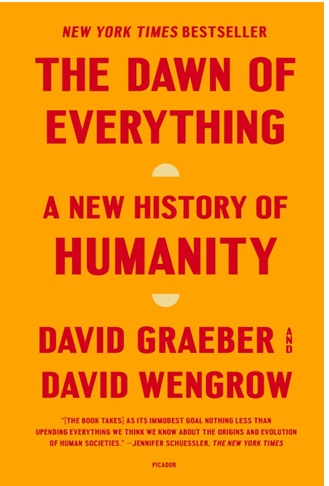
The Dawn of Everything is a 2021 book by David Graeber and David Wengrow that argues human history was far more varied, experimental, and non-linear than the usual story of a simple march from “hunter-gatherers → farming → cities → states.” The book’s core claim is that early societies did not all follow the same path, and that inequality, hierarchy, and government did not emerge in one fixed sequence.wikipedia+1
Main argument
The authors challenge two familiar ideas: that humans began in small, equal, “primitive” groups, and that agriculture automatically created civilization and inequality. Instead, they say people repeatedly organized themselves in many different ways, sometimes becoming more hierarchical and sometimes intentionally avoiding hierarchy.wikipedia+1
Three freedoms
A central part of the book is its idea that many early societies enjoyed three basic freedoms: the freedom to move away, the freedom to disobey arbitrary authority, and the freedom to rebuild society in a different form. The book treats these not as modern inventions, but as ancient human possibilities that were later restricted in many places.wikipedia+1
What the book uses as evidence
The book draws on archaeology and anthropology from many regions, including Japan, the Americas, and the ancient Near East. It uses examples of seasonal political change, large settlements without obvious kings, and societies that chose different social arrangements at different times of year.wikipedia+1
Why it matters
Its bigger message is that the present political order is not inevitable. If humans have organized themselves in many different ways before, then modern hierarchy, bureaucracy, and state power are historical choices rather than the only possible outcome.wikipedia+1
Connection to Jomon Japan
This is where the book becomes especially interesting for Japanese readers. The authors use evidence from Japan as one of the places that complicates the standard “civilization” narrative, because Jomon-era societies do not fit neatly into the idea that agriculture alone produces complex society.wikipedia+1
A good way to read the book in relation to Jomon Japan is this: Jomon society can be seen as an example of how highly developed social life, settlement, ritual, and material culture can exist without a state in the later classical sense. That makes Jomon a useful case for the book’s broader argument that human societies were diverse long before states became dominant.
David Graeber was a professor of anthropology at the London School of Economics. He was the author of Debt: The First 5,000 Years and Bullshit Jobs: A Theory, and was a contributor to Harper’s Magazine, The Guardian, and The Baffler. He was an iconic thinker and a renowned activist, and his early efforts in Zuccotti Park made Occupy Wall Street an era-defining movement. He died on September 2, 2020.
David Wengrow is Professor of Comparative Archaeology at the Institute of Archaeology, University College London and has been a visiting professor at New York University. He is the author of What Makes Civilization? and other books, and co-author with David Graeber of the New York Times bestseller The Dawn of Everything: A New History of Humanity. Wengrow has conducted archaeological fieldwork in Africa and the Middle East, and contributed op-eds to The Guardian and The New York